Tuesday, October 22, 2013

Accel. Chem. Blog 2

Motion of Particles in Matter
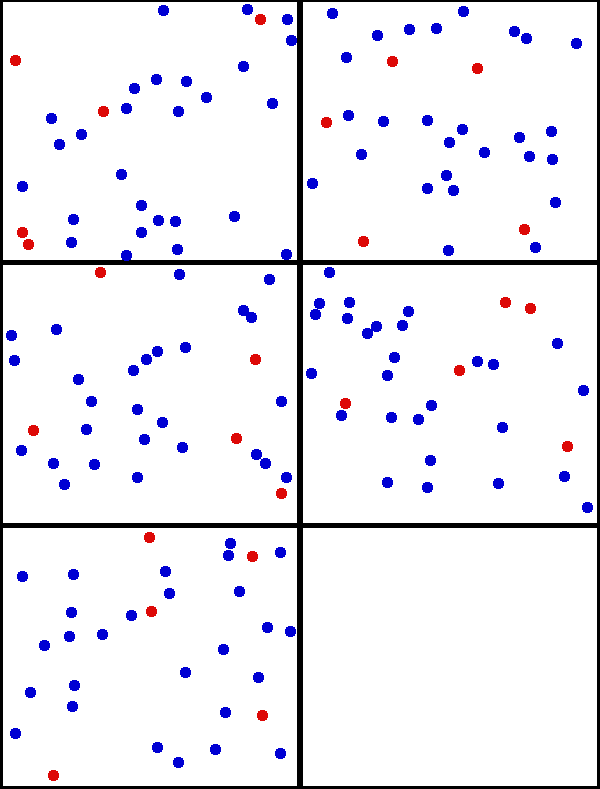

               One of the main areas we covered in this unit was the movement of particles.  The first demonstration used we named "Stink Spray."  When an aerosol can with scented spray was released the odor slowly became apparent to the class.  Starting with people in the front noticing it then heading back.  This demo illustrated how particles travel with other particles similar to diffusion. We also used an experiment using hot and cold water.  When food color was dropped into the two temperatures of water it spread out faster in the warm water.  This is because the warm water has more energy thus moving faster.  We ended this concept with an online simulation similar to the image above, that showed how particles exchanged energy when in motion.  Gas particles roam freely, liquid particles "roll" around each other, and solid particles vibrate.


               The other main concept we covered, in my opinion, was gas pressure.  We did a lab where we inflated a garbage bag with a person on top to show how the particles expand lifting the person.  When the particles hit the side of the garbage bag it pushes the sides out causing it to expand.  We also did a lab where we heated water and alcohol to see how it expands with heat.  One of the other labs, which I thought was important,  demonstrated how an barometer works.  A tube filled with mercury sits in a dish that also has mercury in it. The pressure on that mercury causes the level in the tube to raise or lower showing the air pressure.

               Overall I think we covered some good topics this unit.  The demonstrations and labs we used did a good job of giving a visual.  Everything was well explained and even fun to learn about.

Sunday, September 15, 2013

Accel. Chem. Reflection Blog #1


Matter and Properties


               In accelerated chemistry we started of the year by gaining/refreshing some basic knowledge on matter and it's properties. Some of the terms we covered were: system, surroundings and mass. One main topic which I felt the week lead to was the Law of Conservation of Mass.  Something that I believe messes most people up is the fact that spreading the molecules out in an object doesn't change it's mass. For example. stretching out steel wool didn't change the weight, it just took up more space.

Mass cannot be created nor destroyed.


Physical Change VS Chemical Change


               Another lesson which I thought was important was the difference between a physical and chemical change.  In my opinion one of the hardest things to differentiate for the average person is whether and object changed physically or chemically into a new object.  Most of the labs we did pertained to using heat, acidic and basic chemicals, and creating solutions or changing states of matter.  For example, melting ice. Changing from a solid to liquid is just a physical change. But, a large discussion was related to expansion of molecules with heat because water is the opposite of most substances.


Volume


               The last concept we cover was volume.  In the lab we calculated the volume of a container by measuring it.  Then we filled it with water and found the volume.  At the end we compared cm cubed to ml.  In our discussion we talked about inconsistencies and inaccuracies.  Such as thickness of plastic, curved edges, and "misplaced" water.  Knowing that a cm. cubed is the same as a ml is helpful in my opinion.


Thoughts

               I think that everything we learned this past week will be helpful for the rest of the year.  A lot of topics are more of a review or refresher than new material so far. But that was expected.  The only question or want you could say, that I have would be a list of aspects for both chemical and physical changes. We got pretty good at diagnosing the two but a clear cut list wouldn't hurt me.


Evan Sebranek,
Period 8 Accelerated Chemistry